
 Creditkeeda
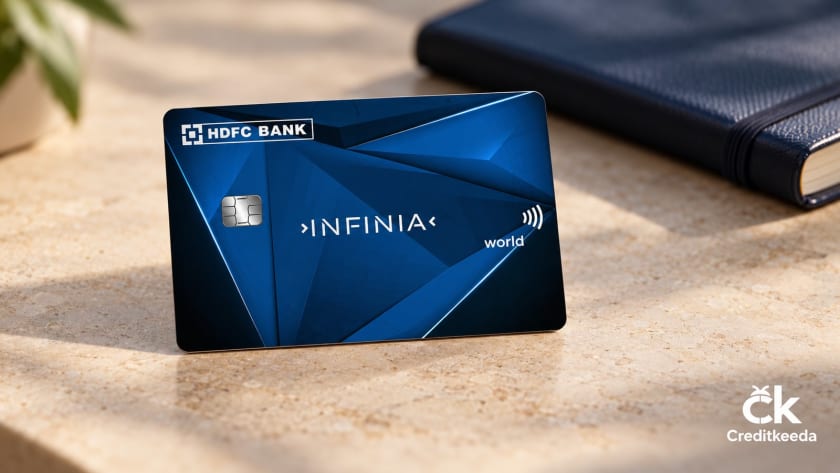
The HDFC Bank Infinia Credit Card makes the most sense if you redeem points for travel and can meet the bank’s ongoing retention criteria. Eligible retail purchases earn 5 reward points per ₹150, worth about 3.33% at the ₹1 travel redemption rate. SmartBuy can lift that substantially, but the advertised 33% hotel return is a capped category rate, not the return on everything you spend.
In a monthly example with ₹60,000 of ordinary eligible purchases, ₹30,000 of SmartBuy vouchers and ₹10,000 of fuel, the card earns approximately 6,000 points: a 6% return across the full ₹1 lakh, before voucher charges and the card fee. That is still useful, but very different from applying the highest multiplier to your whole budget.
This review covers the currently marketed Infinia Metal Edition and is based on HDFC’s published terms checked on 11 October 2026. Older Infinia accounts can have different fee arrangements.
Fees, welcome points and the cost of keeping the card
Item | Current Metal Edition terms |
Joining fee | ₹12,500 + GST; ₹14,750 including 18% GST |
Annual renewal fee | ₹12,500 + GST; ₹14,750 including GST |
Renewal-fee waiver | ₹10 lakh or more in the year before renewal |
Welcome benefit | 12,500 points upon fee realisation and card activation |
Renewal benefit | 12,500 points when the renewal fee is paid |
First-year membership | Complimentary Club Marriott membership |
HDFC publishes a renewal-fee spend waiver, not a standard spend-based joining-fee waiver. A bank-issued first-year-free or lifetime-free offer should be assessed using its own written terms. Fee-linked points are not an extra bonus in a year when the fee is waived.
If you use all 12,500 fee-linked points at ₹1 each, the ₹14,750 fee leaves a ₹2,250 gap. For statement credit at ₹0.30 per point, those same points are worth only ₹3,750. The points soften the fee most when you already have a suitable travel redemption. Club Marriott is a dining and stay-discount membership; it is not Marriott Bonvoy elite status or a free-night award.
Infinia remains invitation-only. HDFC’s official page does not publish a universal salary, existing credit-limit or six-month spending shortcut that guarantees an invitation. An upgrade depends on the bank’s assessment, so the informal income and upgrade cut-offs in the old draft have been removed.
₹10 lakh waives the fee; ₹18 lakh is the retention test
HDFC’s current MITC states that, effective 1 April 2026, continued access to Infinia is aligned to either ₹18 lakh of Infinia spending across the primary and add-on cards in a financial year, or ₹50 lakh of relationship value. The financial year runs from 1 April to 31 March. Relationship value means combined average monthly balances in savings, current, fixed-deposit and recurring-deposit accounts; the published definition does not include outstanding loans.
These are separate tests. Reaching the ₹10 lakh renewal-fee waiver does not, by itself, satisfy the ₹18 lakh retention requirement. If a cardholder falls short, the MITC provides for notification and timelines to meet the criteria, an alternative card with consent, or closure with at least 30 days’ notice. Follow the assessment and deadlines in your own bank communication.
Moving deposits solely to retain a card also has a cost if the money would earn more elsewhere. The rewards need to justify that decision, rather than the card’s exclusivity alone.
How the rewards work now
Purchase | Points and illustrative value at ₹1 per point | Main limit |
Eligible ordinary retail | 5 points per ₹150; about 3.33% | Overall earning cap: 2,00,000 points per statement cycle |
SmartBuy hotels | 10X total; about 33.33% before caps | 15,000 accelerated points per calendar month across SmartBuy |
SmartBuy flights | 5X total; about 16.67% before caps | Shares the overall SmartBuy accelerated cap |
SmartBuy brand vouchers | 5X total; about 16.67% before caps and charges | 3,000 accelerated points per calendar month, within the overall 15,000 cap |
Grocery | Base points | 2,000 points per calendar month |
Insurance | Base points | 10,000 points per month |
Utilities and telecom | Base points | Separate 2,000-point monthly caps for each category |
The multiplier includes the base points. A 5X voucher purchase earns the ordinary 1X plus 4X accelerated points; it does not earn 5X on top of the base rate. HDFC calculates base rewards in complete ₹150 blocks per transaction, so small purchases and rounding can reduce the realised rate.
The separate voucher cap applies to GyFTR and Woohoo purchases through SmartBuy from 1 July 2026. At 5X, roughly ₹22,500 of eligible voucher purchases uses the 3,000-point accelerated allowance. A ₹30,000 voucher purchase then earns approximately 1,000 base points plus 3,000 accelerated points: 4,000 points, or 13.33%, before any processing charge. Check the charge and eligible amount at checkout, especially for vouchers that add a fee.
The maximum uncapped category rate is about 33.33% on eligible 10X hotel spending. With the full SmartBuy allowance unused, roughly ₹50,000 of hotel spending exhausts the 15,000 accelerated-point cap. A ₹60,000 booking earns approximately 17,000 points including base rewards, bringing the return to 28.33%. Other SmartBuy purchases in the same month reduce the allowance available to that booking. Compare the portal’s final price and cancellation conditions with booking direct.
The ₹1 lakh monthly mix in the opening earns 2,000 points on ordinary retail, 4,000 on vouchers and none on fuel. The voucher cap costs it 1,000 points compared with uncapped 5X earning. Illustrative only, actual value varies: these examples assume eligible amounts, no refunds, the stated caps initially available and redemption at ₹1 per point.
Purchases that earn nothing, and charges to watch
Fuel, rent and property-management payments, government transactions, EasyEMI purchases and e-wallet loads do not earn points. Converting a rewarded retail transaction to SmartEMI reverses the rewards. Online skill-based gaming is also excluded. Education paid through third-party apps does not earn points; payments directly to a school or college website or its POS can earn them. Merchant category coding determines how a transaction is treated.
No points does not mean no charge. The current MITC levies a 1% fee on consumer-card utility spending exceeding ₹50,000 in a calendar month, applied to the full utility amount and capped at ₹4,999 before tax. It also charges 1% on qualifying third-party education payments, capped at ₹4,999 per transaction before tax. These fees can outweigh the rewards.
The fuel benefit is a surcharge waiver rather than rewards: HDFC lists 1% on eligible transactions between ₹400 and ₹1,00,000, with a maximum waiver of ₹1,000 per statement cycle. GST on the fuel surcharge is not reversed.
Redemption: travel value is not cashback
Route | Published value | Restriction worth knowing |
SmartBuy flights and hotels | ₹1 per point | Up to 70% of booking value using points; combined travel/airmile redemption cap of 1,50,000 points per calendar month |
Apple products through SmartBuy | ₹1 per point | Up to 70% using points; one product per calendar quarter |
Tanishq vouchers through SmartBuy | ₹1 per point | Up to 70% using points; 50,000 points per calendar quarter |
Other products and vouchers | Up to ₹0.50 per point | Value depends on the catalogue item |
Statement credit | Up to ₹0.30 per point | 50,000 points per calendar month |
Airline and hotel transfers | Partner-specific units; no fixed rupee value | Published terms specify 2 HDFC points to 1 loyalty point for Turkish, Accor and Avianca |
You must fund the balance of a points-assisted travel booking with the card. Do not assume the remaining cash portion always receives the advertised multiplier: check the booking’s reward terms. Apple and Tanishq also require a cash contribution, and compare their portal prices with other available deals.
A transfer ratio describes how many partner points you receive, not what they are worth in rupees. The old draft’s blanket ₹1–₹2 transfer valuation was misleading. Check the live partner ratio, award availability, taxes and cancellation rules before transferring. This review does not assign a speculative value to airline miles.
Points normally expire three years after accumulation, and HDFC’s reward terms also provide for points to be nullified after more than 365 days of card inactivity. Infinia is exempt from the bank’s standard reward-redemption processing fee.
What ordinary spending earns after the fee
The table below assumes all spending earns base points and every point is redeemed at ₹1. It excludes SmartBuy bonuses, lounge value and fee-linked points so the spending return is visible on its own. Spending is spread across transactions; figures are approximate because actual awards use complete ₹150 blocks.
Annual eligible spending | Base reward value | Renewal fee including GST | Net value before fee-linked points |
₹1,00,000 | ₹3,333 | ₹14,750 | −₹11,417 |
₹3,00,000 | ₹10,000 | ₹14,750 | −₹4,750 |
₹5,00,000 | ₹16,667 | ₹14,750 | ₹1,917 |
₹10,00,000 | ₹33,333 | Waived | ₹33,333 |
₹18,00,000 | ₹60,000 | Waived | ₹60,000 |
In a paid-fee renewal year, add the value of the 12,500 renewal points if they are credited and you redeem them. At ₹1 each, those points reduce the effective fee burden to ₹2,250. In a waived-fee year, do not add the renewal points again. The joining-year calculation uses the actual joining fee and welcome points; spending does not automatically waive that joining fee.
Base spending alone recovers the full fee at roughly ₹4.43 lakh. Including the paid-fee points at ₹1 each brings that mathematical break-even to roughly ₹68,000. Neither figure is a retention threshold or a reason to get the card for such low spending: the current ₹18 lakh/₹50 lakh rule is the more important constraint. Illustrative only, actual value varies.
Lounge access, golf and hotel benefits
Primary and add-on cardholders receive unlimited eligible domestic lounge access using their Infinia cards. For international Priority Pass visits, each add-on holder needs their own Priority Pass; entering as the primary holder’s guest is chargeable. Unlimited access does not mean free access for every accompanying person. The linked lounge terms do not impose a quarterly spending gate.
Use the value you would actually pay for access. For illustration, six domestic visits valued at ₹900 each and two international visits at ₹2,700 each produce ₹10,800 of annual use value. Those are CreditKeeda assumptions, not HDFC’s cash benefits. Count less if another card already covers the visits, and zero if you would not pay for a lounge.
HDFC also lists unlimited golf games and lessons at participating courses, a three-night ITC stay for the price of two, a 1+1 ITC buffet offer and first-year Club Marriott membership. Golf depends on the eligible course list and booking terms; the hotel and dining offers depend on participating properties and applicable rates. A non-golfer should value golf at zero, and unused hotel offers should not inflate the card’s return.
The advertised insurance includes accidental air-death cover up to ₹3 crore, emergency overseas hospitalisation up to ₹50 lakh and credit-shield cover up to ₹9 lakh. These are policy limits subject to insurance terms, not annual reward value. They are excluded from the spending table.
Foreign spending and the Global Value Program
The 2% foreign-currency markup becomes 2.36% with GST. On ₹1 lakh of eligible foreign spending, that is ₹2,360, against approximately ₹3,333 of base reward value if redeemed at ₹1 per point. At the statement-credit rate, the rewards are much less valuable. A zero-markup card may still be the simpler choice if you do not want travel points.
The optional Global Value Program costs ₹199 + GST a year, or ₹234.82, and auto-renews. Its current terms offer 1% cashback on eligible non-INR transactions, capped at ₹1,000 per statement cycle, 500 first-year bonus points on the first international transaction and a ₹2,000 travel voucher after ₹1,50,000 of eligible international spending in the programme year. The voucher is not cash and is worth counting only if you can use it.
If ₹1 lakh of eligible foreign spending receives the full ₹1,000 cashback, the markup less cashback plus the programme fee is ₹1,594.82, before ordinary card rewards. So “1.36% forex cost” describes only markup minus cashback before the programme fee and before its cap bites. Pay in the local currency: INR conversion overseas is excluded from GVP benefits and can bring conversion charges.
Infinia or Diners Club Black Metal?
Infinia has the higher SmartBuy allowance and uses Visa or Mastercard rather than Diners Club. Acceptance at the merchants you use matters more than the card’s position in HDFC’s range. Diners Club Black Metal also has a benefit Infinia lacks: 10,000 points after ₹4 lakh of spending in a calendar quarter. Hitting that in every quarter earns 40,000 points in a year, but uneven annual spending does not automatically qualify.
For someone already meeting the Infinia retention criteria and booking travel through SmartBuy, Infinia remains a strong choice. Someone regularly reaching the Diners quarterly milestone should compare the bonus with the SmartBuy rewards they would gain on Infinia. Someone planning mainly statement-credit redemptions, or stretching spending and deposits just to retain Infinia, has a weaker reason to choose it.